
4 Ways AI Is Transforming Home Health Care
4 Ways AI In Home Health Is Transforming How We Care for Patients at Home
Artificial Intelligence, AI-Powered Tools for Home Health, AI Enhancement
Estimated Reading Time: 5 Minutes
This article was researched and structured using artificial intelligence, then thoroughly reviewed, edited, and approved by David Ochoa for industry accuracy and brand alignment.
Key Takeaways
- Artificial intelligence in home healthcare goes far beyond devices — it learns, predicts, and helps clinical teams act before a crisis develops.
- AI-powered tools analyze patterns in real time, giving clinicians a smarter, faster line of sight into each patient's health status.
- Predictive alerts driven by AI reduce preventable hospitalizations by catching subtle changes that humans alone might miss.
- Families across Texas and Oklahoma gain peace of mind knowing an intelligent system — backed by compassionate clinicians — is always watching over their loved ones.
- AI enhances the human touch — it never replaces the relationship-driven care at the heart of everything we do.
- Passion Inspired Care means we pair the most advanced technology available with the warmth and accountability our communities deserve.
Imagine a quiet Tuesday morning. An elderly woman in Prosper, Texas is making coffee, moving a little slower than usual. She hasn't called anyone. She hasn't pressed an alarm button. But something has shifted — her overnight vitals show a subtle pattern that, left unnoticed, could lead to a hospitalization by the weekend.
Now imagine that pattern was caught. Not by luck, but by artificial intelligence working silently in the background — analyzing data, recognizing a trend, and alerting her care team before she even felt the difference.
This is no longer the future of home healthcare. It is happening right now, in homes across Texas and Oklahoma, and it is changing what it means to grow older safely and independently. AI in home healthcare is redefining the standard of care — and for the patients and families we serve, that means everything.
AI Sees What the Human Eye Can't — Until It's Too Late
Traditional home health visits are invaluable, but they are snapshots. A nurse visits, assesses, documents, and leaves. In between those visits, hours and sometimes days pass without clinical visibility. For patients managing congestive heart failure, COPD, diabetes, or hypertension, those hours matter enormously.
Artificial intelligence changes this equation. When paired with connected monitoring devices — smart scales, pulse oximeters, blood pressure cuffs, and glucose monitors — AI doesn't just collect data. It studies it. It learns what "normal" looks like for each individual patient and then watches continuously for anything that deviates from that baseline.
Unlike a standard alert threshold that fires the same alarm for every patient, AI-driven systems are personalized. A two-pound weight gain overnight might be insignificant for one patient and a serious red flag for another. AI knows the difference — and it flags the right concern at the right time, giving clinicians the intelligence they need to intervene with precision.
Predictive Alerts That Stop Hospitalizations Before They Start
One of the most powerful applications of AI in home healthcare is its ability to predict — not just detect. There is a meaningful clinical difference between knowing a patient's blood pressure is elevated right now and knowing that the trend over the past 72 hours suggests a crisis may be building. AI does the latter.
By processing continuous streams of biometric data and comparing them against both individual history and population-level health models, AI can surface early warning signals days in advance. A clinician receives a prioritized alert — not a list of a hundred data points, but a clear, actionable notification that a specific patient needs a proactive intervention today.
For patients managing chronic conditions, this predictive layer is nothing short of life-changing. It breaks the cycle of reactive care — the emergency room visit, the hospitalization, the rushed discharge, and the frightening return trip just weeks later. Instead, care becomes anticipatory. Our teams can adjust a medication, schedule an urgent visit, or coordinate with a physician before the situation ever reaches a crisis point.
AI-Powered Care That Respects Each Patient as an Individual
One concern many patients and families share when they hear the word "AI" is that it sounds impersonal — algorithmic, cold, and disconnected from the human experience of illness and healing. We understand that concern deeply, and we want to reframe it.
The AI tools integrated into our care model are not designed to replace clinical judgment. They are designed to sharpen it. When a nurse receives an AI-generated alert about a patient, she brings her clinical training, her knowledge of that patient's history, and her relationship with that family to every decision she makes in response. The algorithm opens the door. The clinician walks through it.
Moreover, AI helps our interdisciplinary teams — nurses, therapists, social workers, and physicians — work in tighter coordination. When everyone on the care team has access to the same real-time, AI-analyzed data, communication improves, care gaps close, and patients experience a more seamless, cohesive level of support across every touchpoint.
Giving Families the One Thing They Need Most: Confidence
Caring for an aging parent or a loved one managing a serious illness from a distance is one of the most emotionally exhausting experiences a family can face. The worry is constant. The fear of missing something — a fall, a symptom, a quiet decline — never fully goes away.
AI in home healthcare doesn't eliminate that love and concern, but it does give it a foundation of confidence. When families know that an intelligent monitoring system is running continuously in the background — and that a dedicated clinical team is receiving and acting on its findings — the burden of vigilance lifts.
Adult children living hours away can rest knowing that if something changes at 2 a.m. on a Sunday, the system will catch it, the team will respond, and their loved one will not face that moment alone. That peace of mind is not a luxury. For many families we serve across Texas and Oklahoma, it is what makes home-based care possible at all.
Where Centric Is Headed — And Why It Matters to You
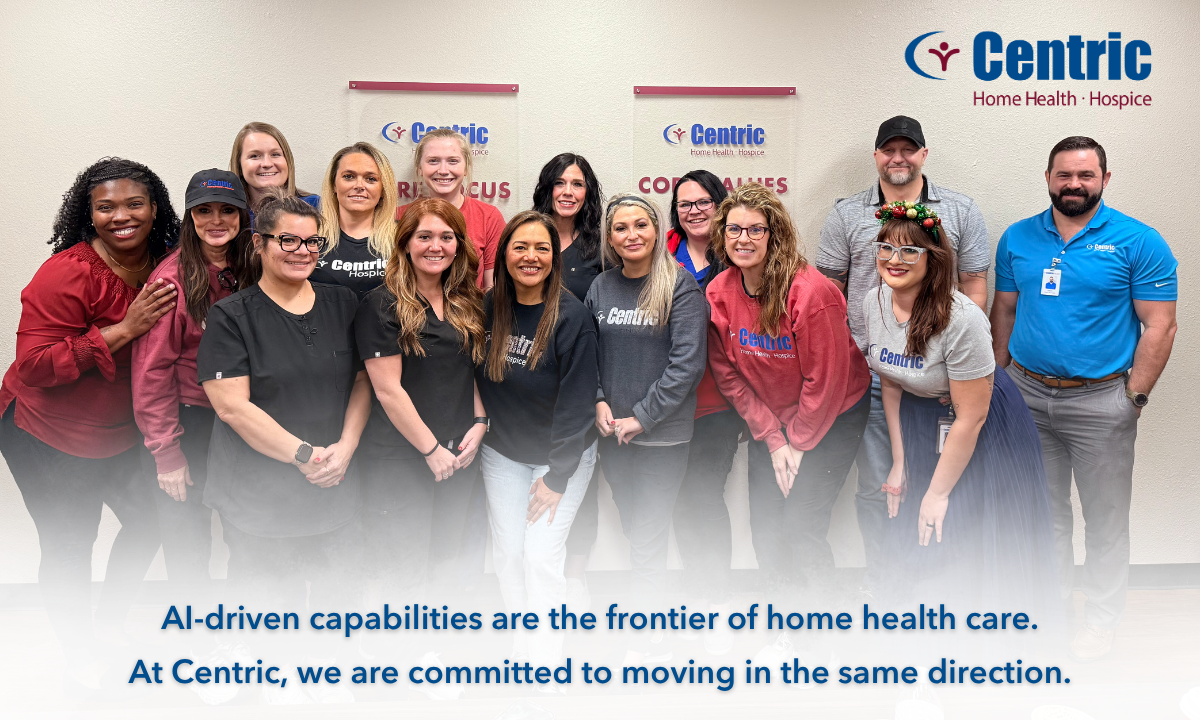
It is important to us that we are honest with the families and patients we serve. The AI-driven capabilities described in this blog represent the emerging frontier of home healthcare — a frontier that leading organizations across the country are actively moving toward. At Centric, we are committed to moving in that same direction.
We are not standing still. As the home health landscape evolves, we are continuously evaluating innovative technologies and care delivery models that align with our mission of providing quality, relationship-driven care to the communities of Oklahoma and North Texas. Our goal is to grow into this future thoughtfully — adopting tools that genuinely serve our patients rather than chasing technology for its own sake.
What that means for you today is this: the team caring for your loved one right now is already grounded in the values that make AI-enhanced care work when it arrives — clinical excellence, proactive communication, and a deep commitment to keeping patients safely at home. We are building toward tomorrow without ever taking our eyes off the care we are delivering today.
At our core, we believe that the best technology in the world is only as good as the people behind it. Artificial intelligence gives our clinicians a sharper set of eyes, a faster line of communication, and a more complete picture of every patient's health. But it is our nurses who make the calls. It is our therapists who show up at the door. It is our care coordinators who know the name of a patient's dog and ask about their grandchildren. That human connection is irreplaceable — and AI exists in our model to protect it, not compete with it.
We are proud to bring this level of intelligent, compassionate care to communities across Texas and Oklahoma. As technology continues to evolve, our commitment remains unchanged: every tool we adopt must serve our patients' dignity, independence, and sense of home. AI is not changing what we care about. It is helping us care better.
The future of healthcare is not in a hospital hallway. It is in the living rooms, kitchens, and quiet mornings of the people we are honored to serve — and we are bringing that future home, one patient at a time.
Passion Inspired Care • Intelligent Clinical Oversight • AI-Powered, Human-Centered
Join us in bringing the future of healthcare home
If you or a loved one are ready to experience how AI-powered home healthcare can protect independence and bring clinical confidence into your daily life, Contact Us today to learn more.
Share This On Your Favorite App